
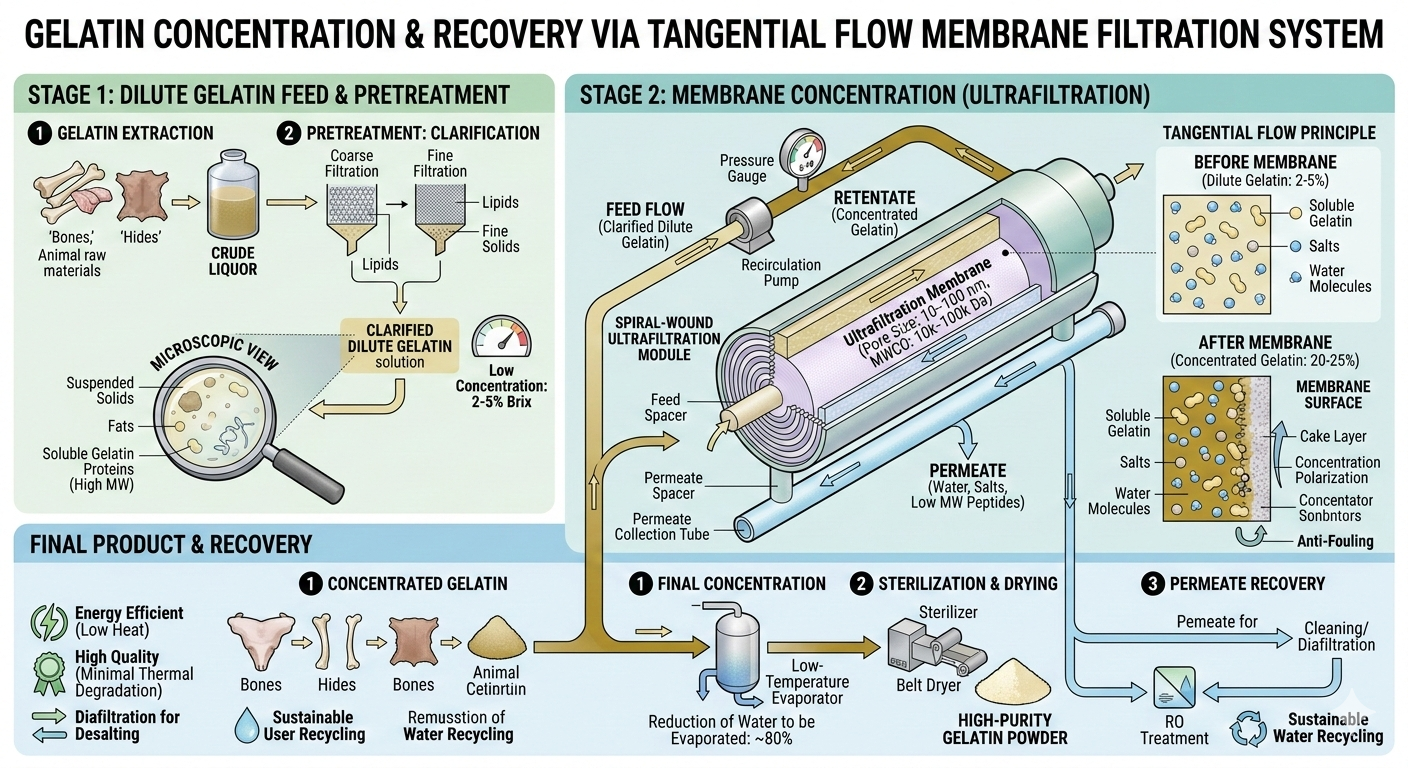
Overview Membrane filtration is used to concentrate gelatin solutions and recover gelatin from process streams. This involves using semi-permeable membranes to separate gelatin (solute) from water and other small molecular weight substances (solvents). Basic Principles Membrane filtration works by applying pressure to force liquid through a membrane while gelatin molecules are retained due to their size and the membrane's selectivity. The key processes used are: Ultrafiltration (UF): Uses membranes with pore sizes of 1-100 nm, ideal for retaining gelatin (molecular weight ~50, 000-250, 000 Da) while allowing water and small ions to pass Microfiltration (MF): Larger pores (0.1-10 μm), often used as a pre-filtration step Nanofiltration (NF): Can work between ultrafiltration and reverse osmosis for some applications The Process 1. Concentration Phase Raw gelatin solution (typically 1-5% gelatin) enters the membrane module Pressure is applied (typically 2-10 bar for UF) Permeate stream: Water and small molecules pass through Retentate stream: Concentrated gelatin solution is retained and recirculated Process continues until desired concentration is reached (10-30% or higher) 2. Recovery Phase Gelatin-rich retentate is collected Can be further processed (evaporation, drying, crystallization) Permeate can be recycled or discharged Key Advantages 1) Selective separation - Gelatin is retained while water and small impurities pass through 2) No thermal degradation - Unlike evaporation, membrane filtration operates at low temperatures (room temp to 40°C), preserving gelatin's gel strength 3) Reduced waste - Concentrated streams reduce subsequent processing needs 4) Quality improvement - Can remove unwanted substances (salts, protein impurities) 5) Energy efficient - Compared to traditional evaporation methods Industrial Applications -Gelatin recovery from processing waste streams -Gelatin purification - removing colloidal impurities -Pharmaceutical grade gelatin - producing high-purity products -Food industry - concentrating gelatin for capsules, gels, etc. -Photographic/coating applications - producing concentrated gelatin for emulsions Integration with Other Processes Membrane filtration typically works with: 1. Upstream: Pre-filtration (MF) to remove large particles 2. Downstream: Spray drying, freeze-drying, or further evaporation of the retentate 3. Parallel: Membrane cleaning systems using caustic or acid solutions Membrane Filtration System Ultrafiltration for Gelatin Concentration Gelatin Recovery Process Industrial Protein Concentration Nanofiltration Membrane Technology Energy-efficient gelatin concentration solutions Cold-processing membrane filtration for food quality Stainless steel tangential flow filtration (TFF) modules Ceramic membrane systems for high-viscosity liquids Wastewater recovery in gelatin manufacturing


This is your website preview.
Currently it only shows your basic business info. Start adding relevant business details such as description, images and products or services to gain your customers attention by using Boost 360 android app / iOS App / web portal.
Gelatin Concentration and Recovery Using Membrane Filtration in India
2026-03-07T11:22:50
Overview Membrane filtration is used to concentrate gelatin solutions and recover gelatin from process streams. This involves using semi-permeable membranes to separate gelatin (solute) from water and other small molecular weight substances (solvents). Basic Principles Membrane filtration works by applying pressure to force liquid through a membrane while gelatin molecules are retained due to their size and the membrane's selectivity. The key processes used are: Ultrafiltration (UF): Uses membranes with pore sizes of 1-100 nm, ideal for retaining gelatin (molecular weight ~50, 000-250, 000 Da) while allowing water and small ions to pass Microfiltration (MF): Larger pores (0.1-10 μm), often used as a pre-filtration step Nanofiltration (NF): Can work between ultrafiltration and reverse osmosis for some applications The Process 1. Concentration Phase Raw gelatin solution (typically 1-5% gelatin) enters the membrane module Pressure is applied (typically 2-10 bar for UF) Permeate stream: Water and small molecules pass through Retentate stream: Concentrated gelatin solution is retained and recirculated Process continues until desired concentration is reached (10-30% or higher) 2. Recovery Phase Gelatin-rich retentate is collected Can be further processed (evaporation, drying, crystallization) Permeate can be recycled or discharged Key Advantages 1) Selective separation - Gelatin is retained while water and small impurities pass through 2) No thermal degradation - Unlike evaporation, membrane filtration operates at low temperatures (room temp to 40°C), preserving gelatin's gel strength 3) Reduced waste - Concentrated streams reduce subsequent processing needs 4) Quality improvement - Can remove unwanted substances (salts, protein impurities) 5) Energy efficient - Compared to traditional evaporation methods Industrial Applications -Gelatin recovery from processing waste streams -Gelatin purification - removing colloidal impurities -Pharmaceutical grade gelatin - producing high-purity products -Food industry - concentrating gelatin for capsules, gels, etc. -Photographic/coating applications - producing concentrated gelatin for emulsions Integration with Other Processes Membrane filtration typically works with: 1. Upstream: Pre-filtration (MF) to remove large particles 2. Downstream: Spray drying, freeze-drying, or further evaporation of the retentate 3. Parallel: Membrane cleaning systems using caustic or acid solutions Membrane Filtration System Ultrafiltration for Gelatin Concentration Gelatin Recovery Process Industrial Protein Concentration Nanofiltration Membrane Technology Energy-efficient gelatin concentration solutions Cold-processing membrane filtration for food quality Stainless steel tangential flow filtration (TFF) modules Ceramic membrane systems for high-viscosity liquids Wastewater recovery in gelatin manufacturing
2026-03-07T11:22:50


Keywords
- wastewater recovery in gelatin manufacturing
- food industry gelatin concentration
- pharmaceutical grade gelatin production
- gelatin concentration membrane system
- energy-efficient membrane filtration processes
- gelatin purification from waste streams
- industrial protein concentration solutions
- nanofiltration gelatin concentration
- ultrafiltration membrane technology
- membrane filtration for gelatin recovery
Submit Your Enquiry