

Description
Product details
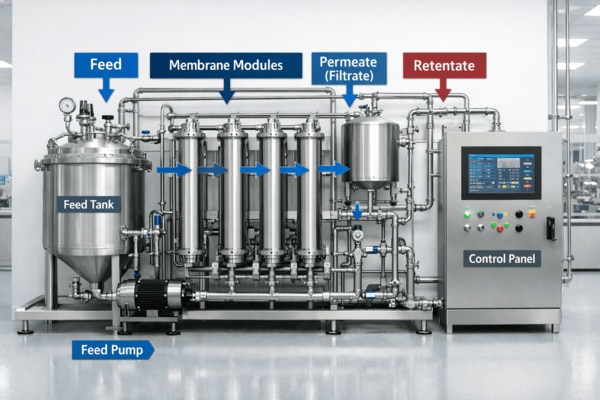
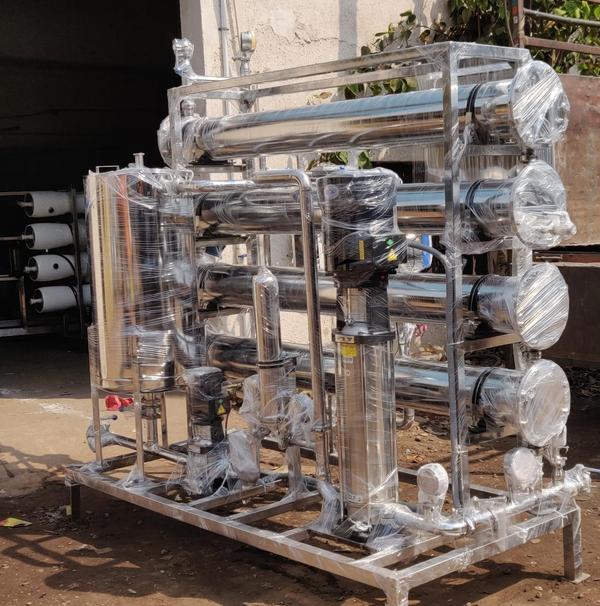
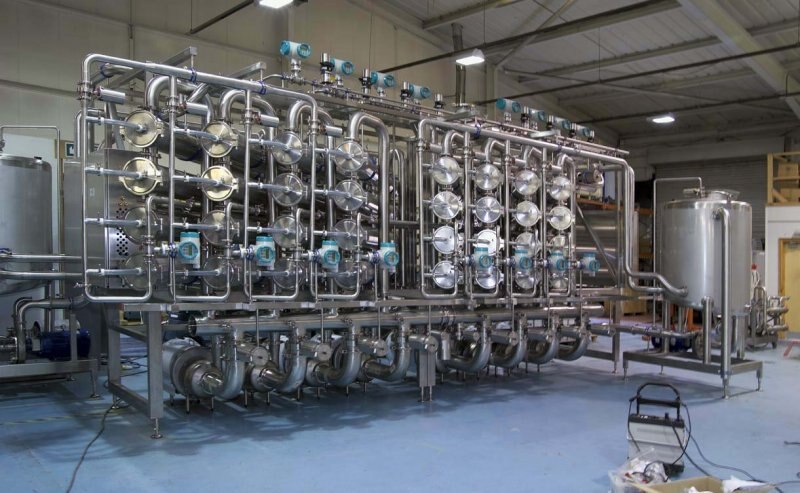
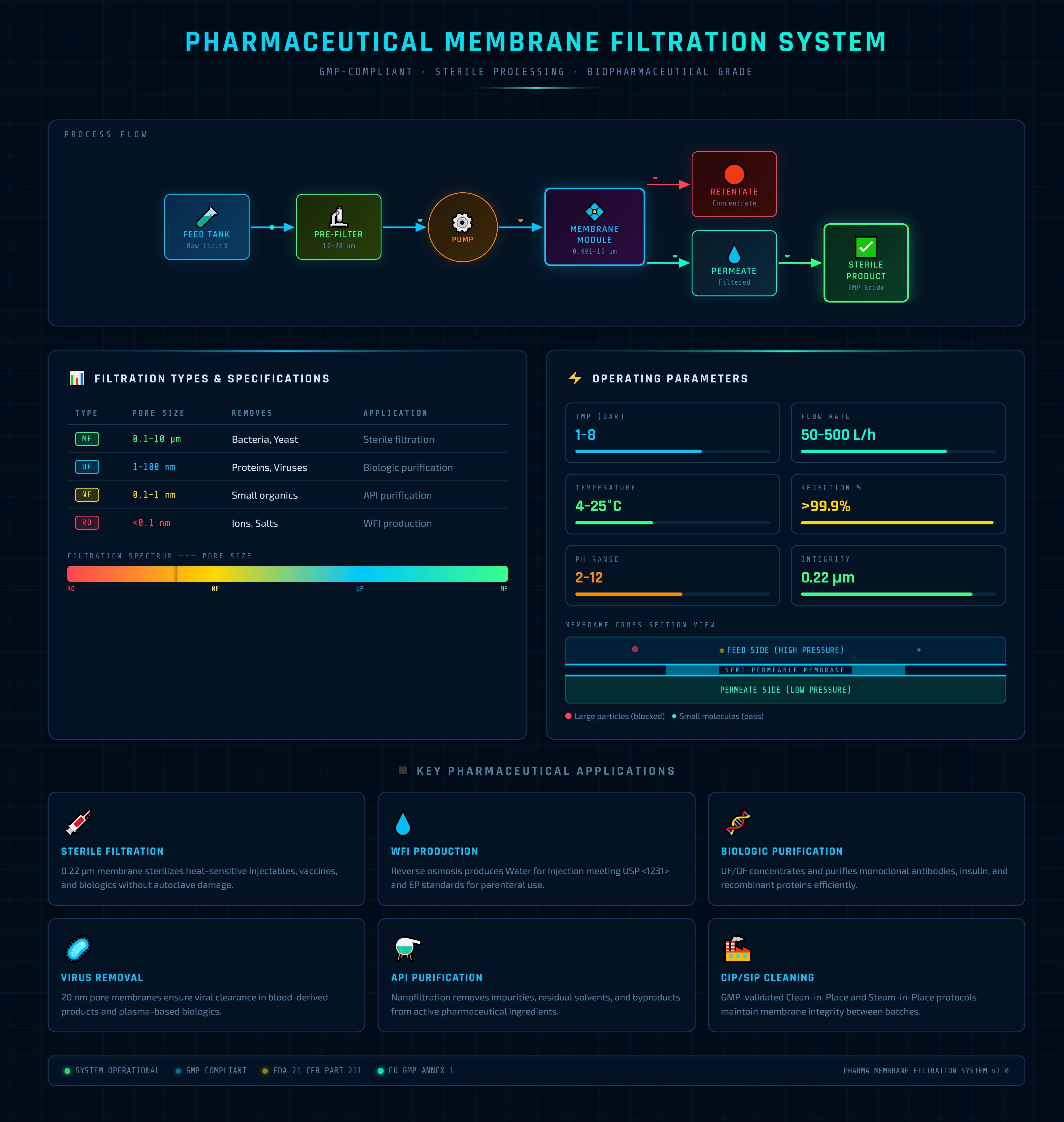
Membrane Filtration in Pharmaceutical Industries Membrane filtration is a pressure-driven separation process that uses semi-permeable membranes to remove particles, microorganisms, and macromolecules from liquids and gases in pharmaceutical manufacturing. How It Works A feed solution is passed through a membrane under applied pressure. The membrane acts as a selective barrier — allowing some components (permeate) to pass through while retaining others (retentate), based on pore size, charge, and molecular weight. Types of Membrane Filtration Type Pore Size What It Removes Pharma Use Microfiltration (MF) 0.1 – 10 µm Bacteria, particulates, yeast Sterile filtration, clarification Ultrafiltration (UF) 0.001 – 0.1 µm Proteins, viruses, colloids Protein concentration, buffer exchange Nanofiltration (NF) 0.0001 – 0.001 µm Small organics, divalent ions Solvent recovery, desalting Reverse Osmosis (RO) <0.0001 µm Monovalent ions, small molecules Water purification (WFI production) Key Applications in Pharma 1. Sterile Filtration The most critical use — 0.22 µm filters are used to sterilize heat-sensitive products (APIs, biologics, vaccines) that cannot be autoclaved. 2. Water Purification RO and ultrafiltration produce Purified Water (PW) and Water for Injection (WFI) — essential utilities in all pharma plants per USP/EP standards. 3. Bioprocessing & Biopharmaceuticals UF/DF (Ultrafiltration/Diafiltration) is used to concentrate and purify monoclonal antibodies, insulin, hormones, and recombinant proteins. 4. Virus Removal Dedicated virus filtration membranes (20 nm pore size) are mandatory in blood-derived products and biologics to ensure viral safety. 5. API Purification Nanofiltration removes impurities and residual solvents from active pharmaceutical ingredients. 6. CIP/SIP Validation Membranes used in closed systems undergo Clean-in-Place and Steam-in-Place validation to meet GMP requirements. Membrane Materials Used *PVDF (Polyvinylidene fluoride) — chemical resistance, sterilization *PES (Polyethersulfone) — low protein binding, sterile filtration *Cellulose acetate — aqueous solutions, low cost *PTFE — solvent filtration, vent filtration *Nylon — broad chemical compatibility Regulatory & GMP Considerations: *Filters must be validated for bacterial retention (ASTM F838), extractables/leachables, and integrity. *Integrity testing (bubble point test, diffusion test) is performed before and after use to confirm membrane performance. *Compliance with FDA 21 CFR Part 211, EU GMP Annex 1, and USP <1229.5> is mandatory. *Filter suppliers must provide Drug Master Files (DMFs). Advantages *No heat required — ideal for thermolabile compounds *No chemical additives needed *Scalable from lab to industrial scale *Consistent, reproducible results *Supports continuous manufacturing trends Limitations *Membrane fouling reduces efficiency over time *High capital cost for large-scale UF/RO systems *Limited to liquid/gas phase — not suitable for solid separations *Requires rigorous validation and documentation Membrane filtration is a cornerstone of modern pharmaceutical manufacturing, underpinning everything from clean water supply to the production of life-saving biologics.